


Combing
The process that aligns the wool fibers and removes the shortest ones, producing a fine and uniform top. Essential for smooth, high-quality yarns.
Drafting
The combed top is gently stretched and equalized to reach the exact fineness and consistency required before spinning.
Double Jersey Knit
A knit similar to plain knit, but characterized by a much more compact structure that makes it stretch, comfortable, and perfect for more formal occasions too.
Fully-fashioned
Panels are shaped directly on the machine, not cut, by decreasing the number stitches. For a cleaner fit and less waste.
Gauge
Number of needles per inch on the machine. A higher gauge means a finer knit; a lower gauge means chunkier.
Hand-feel
Linen has a drier hand, cotton feels round, wool feels rich. It’s the language used to describe how a material responds to touch, much like tasting a wine.
Hand-linking
What makes knitwear truly high-quality. Loop-by-loop joining of panels on a linking machine, resulting in premium seams.
Interlock Knit
A smooth and uniform-looking knit stitch with a dense workmanship that makes it similar to woven fabrics. Knit-stitch pieces are durable jackets and overshirts with a finished, sophisticated look.
Micronage
Measures the diameter of a fiber. The lower the value, the finer and softer the fiber feels on the skin. This is what gives materials like cashmere and fine wool their characteristic softness.
Plain knit
Basic knitting structure with uniform stitches: it has a face side with the characteristic “V” pattern and a back side with a wave-like texture.
Rib Knit
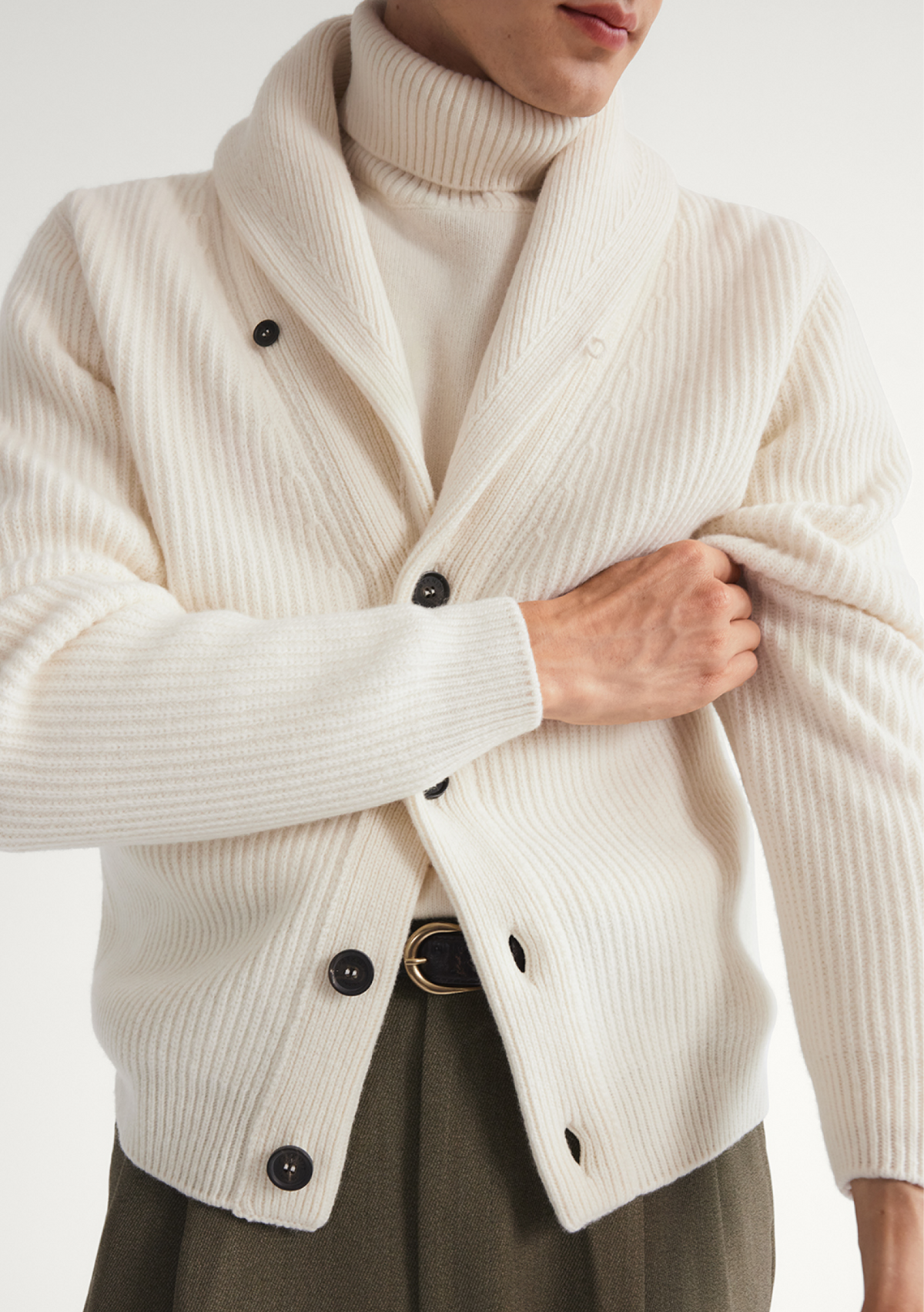
Ribs are created by alternating face and back loops, resulting in tight ribs, which make the knit more compact and elastic, or wider ribs, which create a delicate striped texture. It is a perfect knit stitch to wear every day and gives pieces a refined touch.
Staple Length
Refers to the length of the fibers that make up the yarn. Longer fibers create stronger, smoother, and more uniform yarns, while shorter fibers are used for carded yarns, which feel softer and appear slightly more textured.
Spinning
The drawn fibers are twisted into continuous yarns, balancing strength, elasticity, and handfeel. The moment when fiber becomes thread.
Twist
Indicates how tightly a yarn is twisted. A higher twist results in a stronger, more defined yarn, while a lower twist makes it softer, but also more delicate.
1-ply, 2-ply...
The invisible architecture of the yarn: the number of strands twisted together. Single-ply knits feel lighter and more open; two-ply knits are more compact, with a fuller hand.

WORLDWIDE SHIPPING AND EASY RETURNS
Shipping is free within the EU for orders over €250. Size exchanges are free in the EU, and returns are quick and easy, with our customer service ready to assist you.

ORDER ONLINE AND PICK UP YOUR ORDER
Choose between in-store pickup or InPost 24/7 Locker & Pickup Points at checkout, and collect your order whenever and wherever it suits you best with no shipping costs for in-store pickup.

PAY A LITTLE AT A TIME
You can pay directly from our website in three monthly installments without interest, by selecting Scalapay at checkout and creating an account in just two minutes.

DIGITAL PRODUCT PASSPORT
You can always know who crafted your piece and where the raw material came from by going through its journey on every product page.

THE REPAIR PROGRAM
The Repair Program aims to make your Artknit’s pieces look as good as new, in order to reduce waste and extend your knits’ lifecycle.